On the importance of original thought
Original thought is the catalyst for disruptive change and discovery. The conception of fire, the invention of the spear for hunting, the theory of relativity, and the proof of Earth’s revolution around the sun all began as acts of original thinking. What defines an original thought is not that it appears from nothing, but that it emerges from prior thought and challenges it. Human progress is, in many ways, a continuous process of refining, disproving, and reconstructing older ideas in order to better align our understanding with the laws of nature.
But what happens when original thought becomes increasingly rare?
To answer this, we must first understand why human beings think at all. We think because something feels incomplete, uncomfortable, inelegant, or untrue. Thought is born from friction with the status quo. More deeply, we think because we are driven by a desire to understand the world: why nature behaves as it does, why reality possesses such complexity and beauty, and how we fit within it. In this sense, thinking is not merely an intellectual exercise; it is a form of participation in life itself. To think deeply is to engage fully with existence.
We are now entering an age in which portions of human thought are increasingly outsourced. This is not entirely catastrophic, nor is all outsourcing undesirable. Repetitive and deterministic tasks should indeed be delegated to machines. However, creative, inquisitive, and interpretive thought should not. When we externalize too much of our reasoning, we risk weakening the very faculties that allow us to question, discover, and create.
The evolution of thought has always been tied to humanity’s pursuit of understanding and comfort. Yet modern society has achieved such unprecedented convenience that many intellectual struggles are now softened or bypassed entirely. Even conversation itself is increasingly mediated through generative systems. This matters because discussion, disagreement, and reflection are among the primary catalysts for original thought.
When individuals become overly agreeable with inherited answers, familiar patterns, or machine-generated conclusions without asking whether a deeper truth exists, whether a more elegant explanation is possible, or whether an entirely different approach could emerge, creativity begins to stagnate. We risk suppressing the productive chaos that drives intellectual and artistic progress; the anarchy of thought that has historically propelled humanity forward.
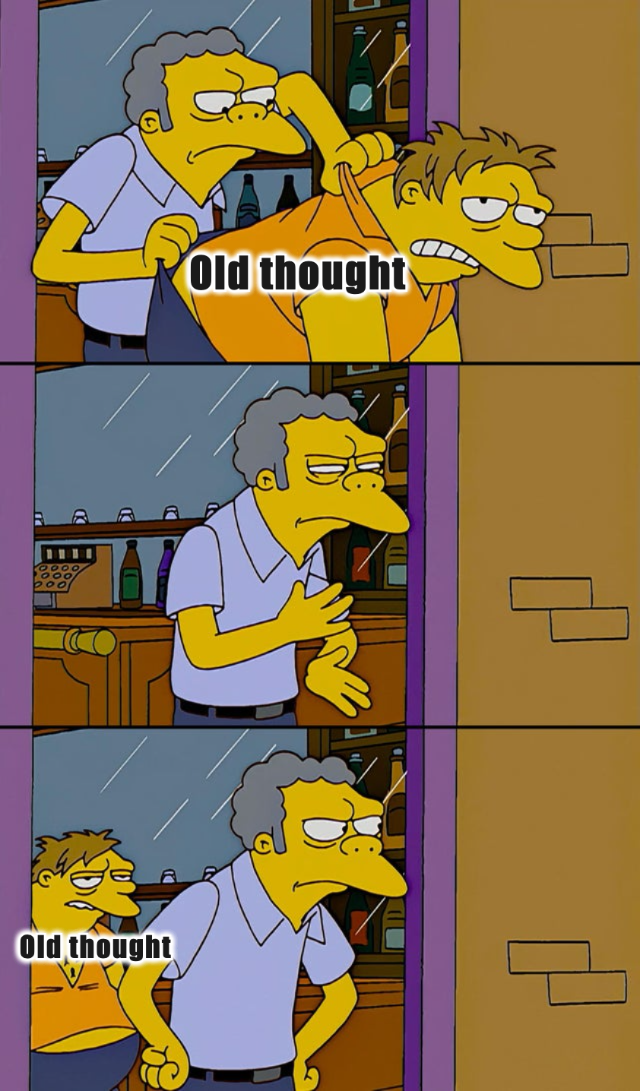
Artificial intelligence is undeniably useful, and it is here to stay. We should use these tools to organize information, accelerate routine work, and expand access to knowledge. However, there is a profound difference between augmenting human reasoning and abandoning it. If we fully eject ourselves from the process of questioning, interpreting, and reasoning, we reduce thought to the repetition of inherited patterns.
Thinking is both the defining burden of modern human existence and the ultimate source of artistic freedom. Without it, life may become more efficient, but also flatter, narrower, and less alive. The danger is not that machines will think for us; it is that we may gradually stop demanding thought from ourselves.